
Beaches: The Overlooked Engine of the American Economy
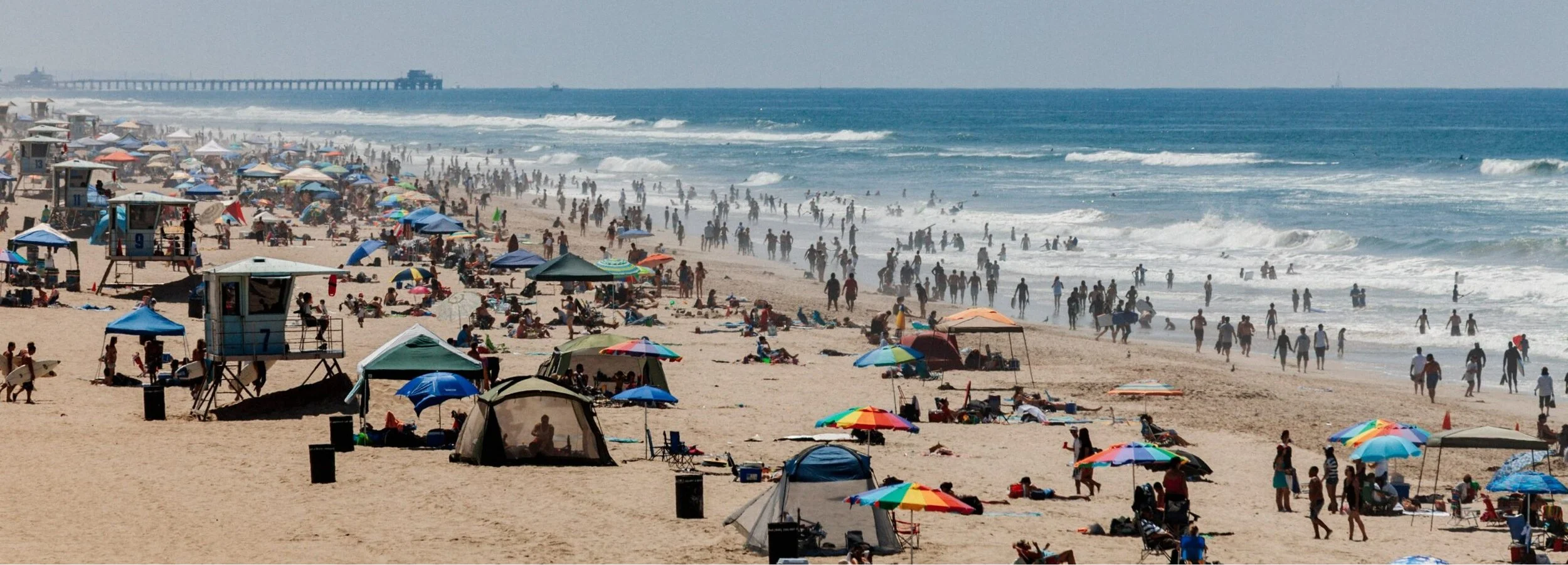
Photo: Jeremiah Klein
Stand on almost any shoreline today — from Malibu to Miami, Sydney to San Clemente — and you’ll see the same hard truth written in the sand: our beaches are disappearing. Not because nature failed us, but because we re-engineered nature to suit ourselves.
Over the past century, coastal counties have exploded in size. To make room for homes, businesses, roads, and railways, we’ve dammed rivers, rerouted waterways, and severed beaches from their natural sand supply. In their natural state, beaches are slow-moving rivers of sand — but we’ve choked those rivers upstream. Every jetty and breakwater has splintered once-connected coastlines into isolated sub-cells.
To fix that, the world’s most popular coastlines have become man-made ecosystems, each requiring its own nourishment strategy to survive. Yet we still struggle to see that truth clearly.
In the U.S., this engineered reality has created a paradox: along both coasts, we’ve built trillion-dollar economies around the beauty of beaches while investing next to nothing to sustain them. The blindness is real.

Coastal armoring in San Clemente. Photo: Klein
Beaches Are Big Business
Believe it or not, travel and tourism make up one of America’s biggest industries — larger than you might think. It’s the nation’s top services export, employs tens of millions, and drives over two trillion dollars in annual spending. And within that, beach travel reigns supreme — accounting for nearly half of all U.S. tourism activity.
Coastal researcher James R. Houston highlighted just how deeply ingrained beachgoing is in American life: 47% of Americans visit a beach each year, 15% go monthly, and only 7% say they never go. Beaches are also the top draw for international visitors — unsurprising when 85% of global tourism is coastal.
According to Houston, U.S. beaches attract 180 million annual visitors, generating 3.4 billion total visits. Those visits translate into $240 billion in direct spending and $520 billion in total economic output. Beach tourism is one of the few U.S. sectors that enjoys a trade surplus — about $84 billion a year.

Priceless in Orange County. Photo: Jeremiah Klein
Globally, the pattern holds. The World Economic Forum reports that coastal and marine tourism make up half of all global tourism. The World Bank estimates that equals roughly 10% of global GDP.
Simply put: beaches aren’t just places to play, relax, or heal — they’re economic engines and the lifeblood of coastal communities. They sustain hotels, restaurants, transport, retail, and recreation industries around the world. Surfers have seen this firsthand, watching entire economies spring up around high-quality breaks, call it the “Waikiki effect”.
Save the Waves has documented the economic value of surf breaks across regions — from Mexico and Malibu to Mundaka. Their recent study found that Santa Cruz’s surf breaks generate $194.7 million annually for the local economy.

Steamer Lane, Santa Cruz. Photo: Jeremiah Klein
Even in the chilly U.K., beach-related tourism accounts for 20% of total tourism income. In Australia — a nation of coastal economies — the state of New South Wales recently launched the Beach Values Estimation Tool (BVET) to quantify three metrics:
•The annual value of benefits to beach users
•The value to tourist-related businesses
•The value of a beach as a natural feature
More than 900 beaches are being measured, but early findings are clear: wider beaches attract more visitors — and higher value.
Last month, we covered how Australia’s Gold Coast became a global leader in coastal resilience, integrating beach, surf, and infrastructure protection. The results speak for themselves: in 2024, the region surpassed $8 billion in travel and tourism revenue for the first time. Beaches are their shining star.

Snapper from above. Photo: Andrew Shield
If assigning economic value to beaches feels awkward, remember that we did exactly that over a century ago to justify creating the National Park System. Robert Sterling Yard, who led that effort in 1916, wrote of the “incalculable value” of parks if managed properly — and he was right.
Today, national parks are revered as treasures. Beaches, however, remain an afterthought — even though they outdraw parks ten to one. National parks generate $26 billion in annual spending; beaches generate $240 billion. Yet we invest $4.5 billion a year in parks and only $440 million in beaches. That’s $9.79 per park visit versus just three cents per beach visit.
That’s not okay.
In August 2020, the Great American Outdoors Act passed with overwhelming bipartisan support. It was the most significant conservation funding law in half a century — repairing trails, roads, visitor centers, and wastewater systems. But it offered no direct funding or policy provisions for coastal resilience, shoreline management, or beach nourishment. From a policy standpoint, America’s beaches are neglected orphans.
Why? Because unlike national parks, no single agency oversees them. Instead, a patchwork of overlapping authorities governs the shore — often at odds with one another. Navigating, let alone untangling, that web is no small feat.

10 million people live in Los Angeles County. Here’s a moment of solitude, brought to you by the wide, sandy expanse of Zuma Beach. Photo: Jeremiah Klein
Our Living Infrastructure
Given the enormous role beaches play as living infrastructure, this fragmentation puts our coasts—and our economies—at risk. Beyond being sanctuaries and economic engines, healthy beaches are our first line of defense against rising seas, storm surges, and erosion.
The data are clear: natural infrastructure pays for itself many times over. After hurricanes like Sandy and Matthew, nourished beaches reduced damages by up to 90%, saving $5–$6 for every $1 invested. Wide beaches aren’t just good stewardship—they’re sound fiscal policy.
The case of Miami Beach is legendary. By the 1970s, its coastline had nearly vanished, along with its economy. After restoration in the 1980s, tourism exploded. Within a year, visitor spending rose $290 million, and the federal government saw a 4,000-to-1 return on investment. Miami remembered that lesson — but Washington hasn’t.

Marley Puglielli pulls in during a window of epic surf at South Beach, Miami. Pre-nourishment, this wasn’t even a wave. Photo: David Hernandez